Owner money: capital, drawings and loans
Money an owner puts into the business, or takes out of it, is not income and not an expense. It changes what the owner has in the business, not the profit, and it never carries VAT. Easy has its own way to record it through the cashbook: Owner money in for capital or a shareholder's loan, and Owner money out for drawings, a loan repaid or a dividend. Whoever keeps the books does it (anyone who can record receipts and payments); adding the shareholder accounts to the chart (Step 4) needs accounting set-up rights. It is an ordinary receipt or payment underneath, so read it with Receipts, payments and transfers. The dividend side continues in the Company income tax return.
About the screenshots
These are from a separate practice company, not the demo company Little Polynesian Café. Recording owner money moves the bank balance, and the Add shareholder accounts button adds two accounts to the company's chart of accounts, which the demo's other chapters rely on staying as they are. The five entries pictured (capital $20,000, drawings $1,500, a shareholder loan $10,000, a $2,500 repayment and a $3,000 dividend) are all for a made-up owner, Mere Teaurima. Other figures on the balance sheet picture come from other made-up entries in that company. Email isn't set up, so the email buttons are greyed out.
Before you start
- Know which kind of business you are. The right account depends on it (Step 1).
- You have a bank or cash account in your books currency for the money to go through. If not, the form says Add a bank or cash account in your books currency in Chart of accounts.
- Ask your accountant if you are unsure whether money was a loan, capital or a dividend. Changing it later means a journal between the two owner accounts (Easy's Help).
Step 1. Choose the right owner account
An owner entry names one owner account. Which accounts you have depends on the kind of business, and the rules come from Easy's Help (Which account to use).
| Kind of business | Money in | Money out |
|---|---|---|
| Sole trader or partnership | Owner's Equity: capital you put in | Owner's Drawings: money you take out for yourself. Both are already in the chart. |
| Limited company | Shareholder Current Account (a liability): a shareholder's money is usually a loan the company owes back, not capital | The same Shareholder Current Account to repay it; Dividends Paid for a dividend, which the company tax return reports on its own |
In a limited company, Add shareholder accounts (Step 4) adds the Shareholder Current Account and Dividends Paid to the chart. To keep one account per shareholder, add more liability accounts in Settings → Chart of accounts and switch on Owed to an owner on each (from Easy's Help; not pictured).
Step 2. Record money the owner puts in
Cashbook → Receipts → + Record receipt, then under What is this for? choose Owner money in. (The Record receipt and Record payment buttons at the top of the owner money report, Step 6, open the same form already set to owner money.)
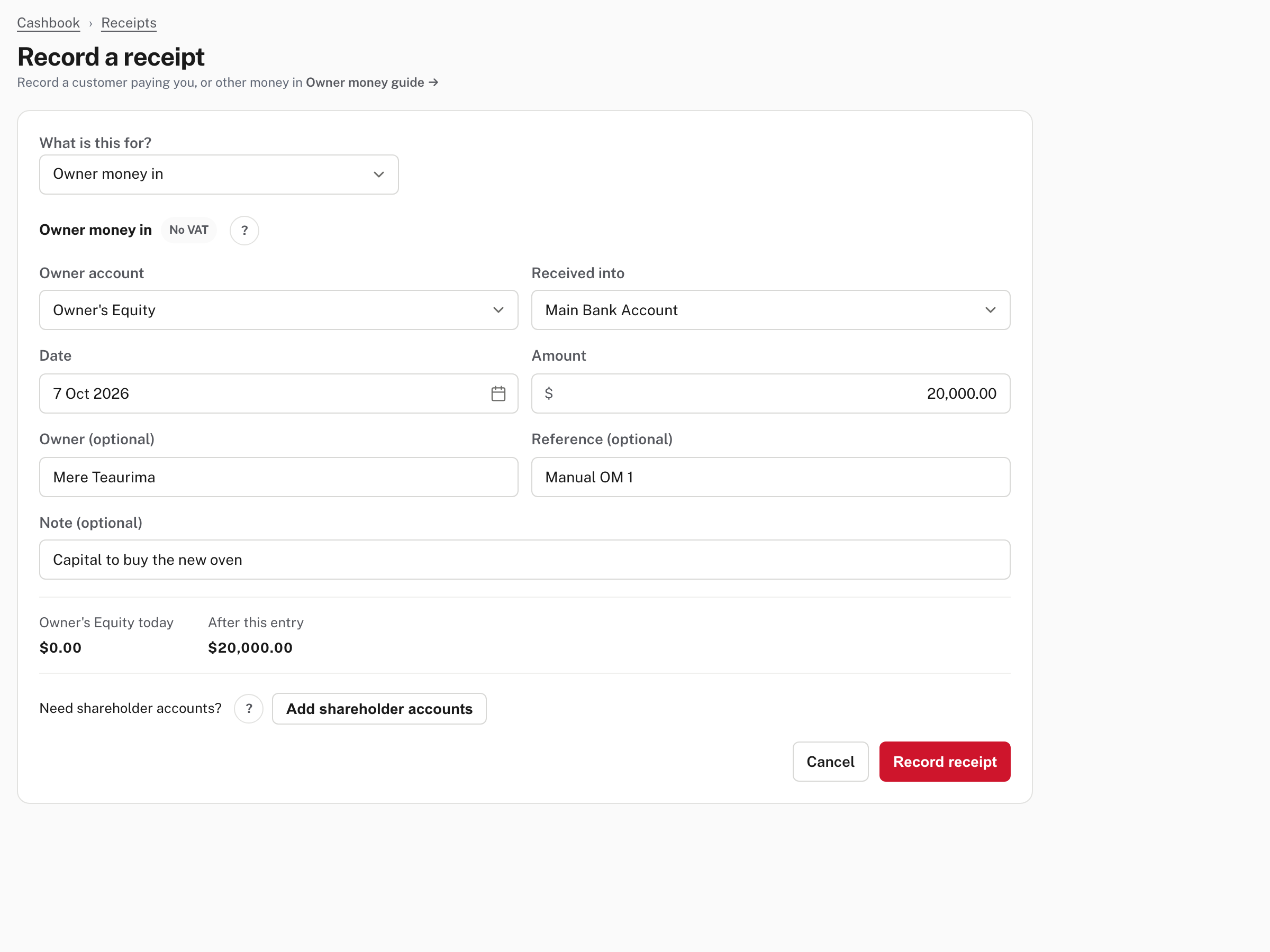
| Field | What it does |
|---|---|
| Owner account | The account the money goes to. Here Owner's Equity. A badge reads No VAT. |
| Received into | The bank or cash account the money went through. If you have only one, Easy chooses it. |
| Date and Amount | The day it moved, and how much. |
| Owner (optional) | Who put it in. Typed text, it shows in the lists and the report. |
| Reference (optional) | Your own reference (here Manual OM 1), to find the entry again. |
| Note (optional) | A line for later, such as Capital to buy the new oven. |
Under the fields a line shows the owner account today and After this entry: $0.00 becoming $20,000.00. Check it, then choose Record receipt.
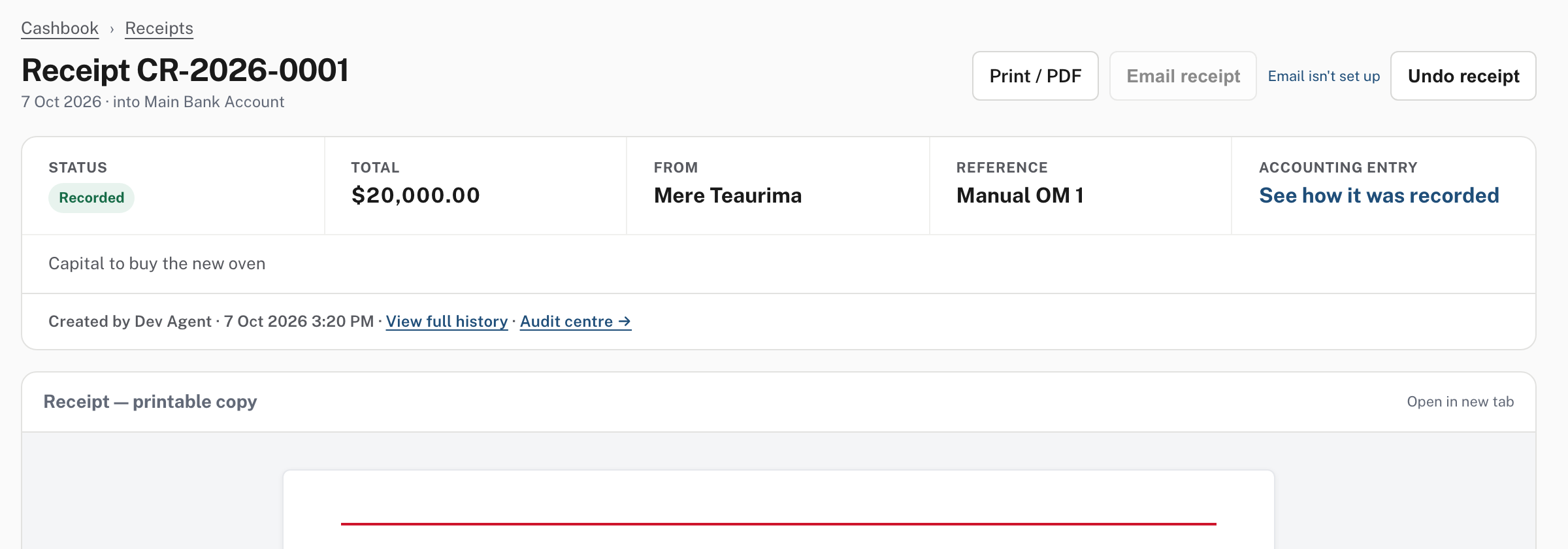
You land on an ordinary receipt (here CR-2026-0001), Recorded, with the owner's name under From. It prints and is undone like any other receipt (its page has Print / PDF and Undo receipt).
Money in is not a customer payment
Don't record an owner's money as a customer payment or as other income. It would add to your profit and, if a VAT code were chosen, to your VAT. Choose Owner money in so neither happens.
Step 3. Record money the owner takes out
Cashbook → Payments → + Record payment, then What is this for? → Owner money out.
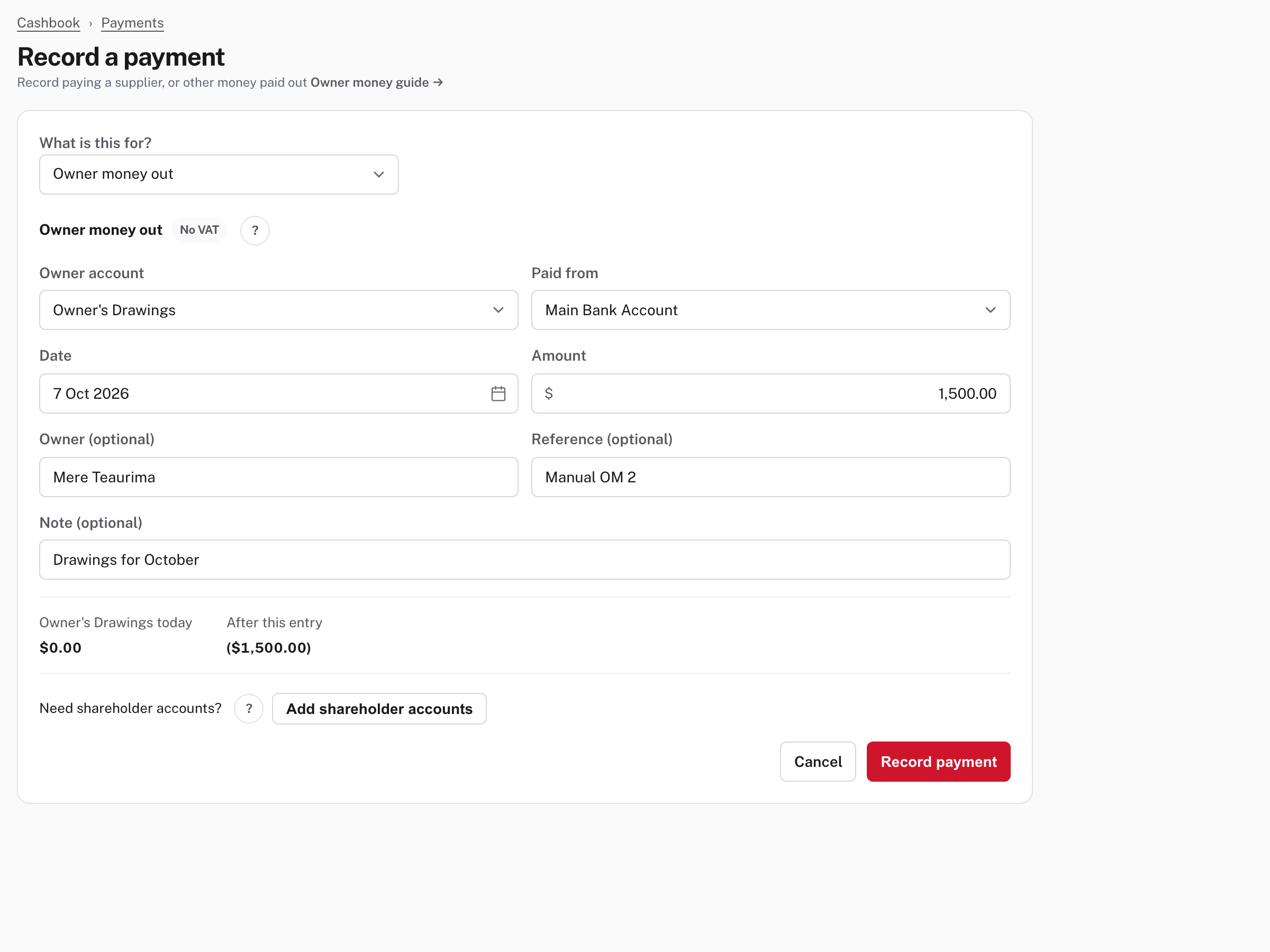
The form is the same, with Paid from instead of Received into. For drawings, choose Owner's Drawings. The preview after this entry reads ($1,500.00) in brackets: Drawings is a negative balance inside equity, which is what taking money out looks like. Choose Record payment.
Step 4. A limited company: the shareholder's loan, its repayment and a dividend
On the form (receipt or payment), the line Need shareholder accounts? has Add shareholder accounts. It adds a Shareholder Current Account (a liability, for money owed to shareholders) and Dividends Paid (for distributions) to your chart. It is shown only until the company has a shareholder account, and only someone who can set up accounting sees the button (others see Ask someone who manages Settings, from Easy's source). When it has worked, a green line reads Shareholder accounts are ready in your chart of accounts, and the new account is chosen for you.
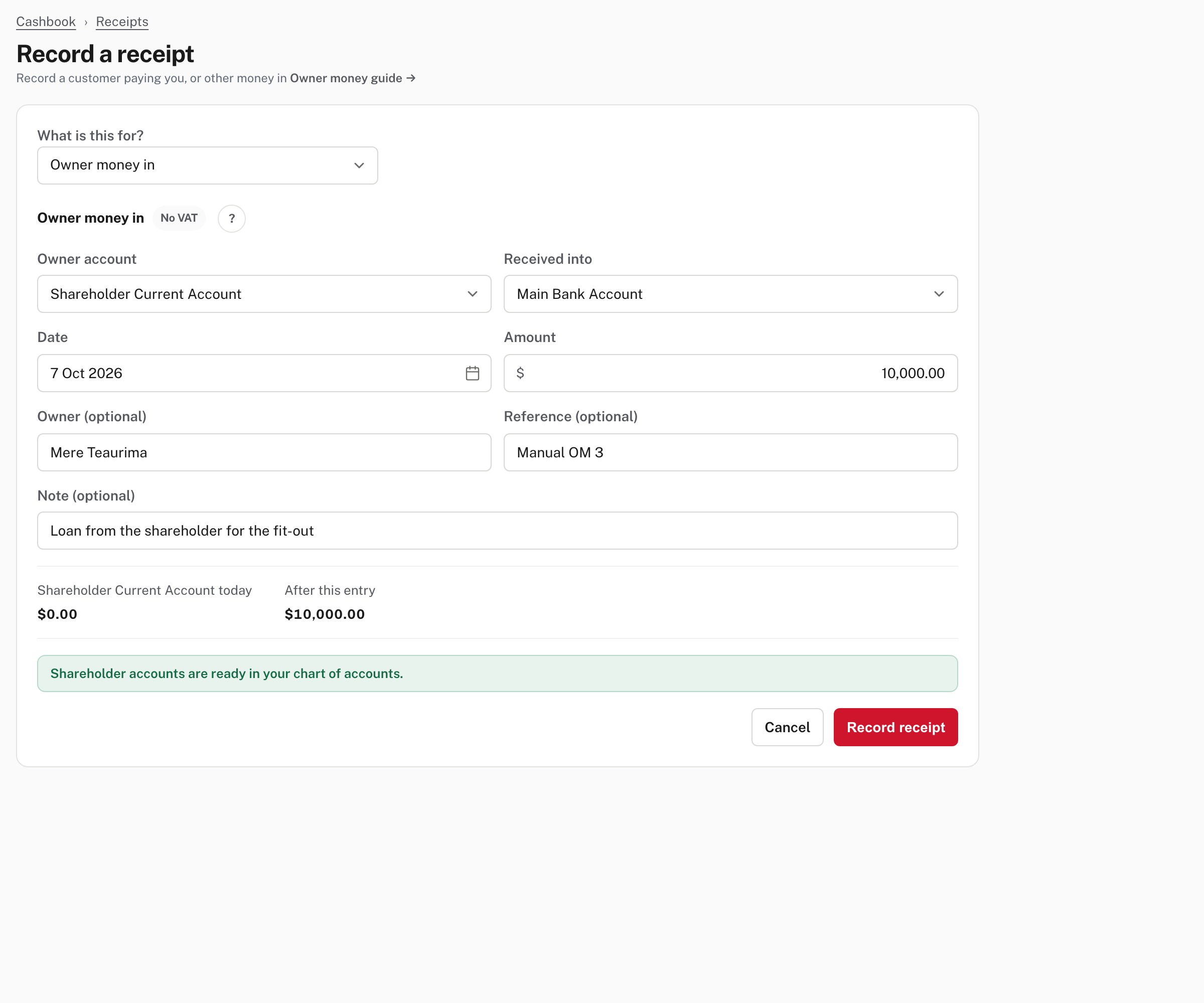
- Loan in. Owner money in to the Shareholder Current Account. The preview shows the account going from $0.00 to $10,000.00: the company now owes the shareholder that much.
- Repayment. Owner money out from the same account. A repayment of $2,500 leaves $7,500 owed.
- Dividend. Owner money out to Dividends Paid:
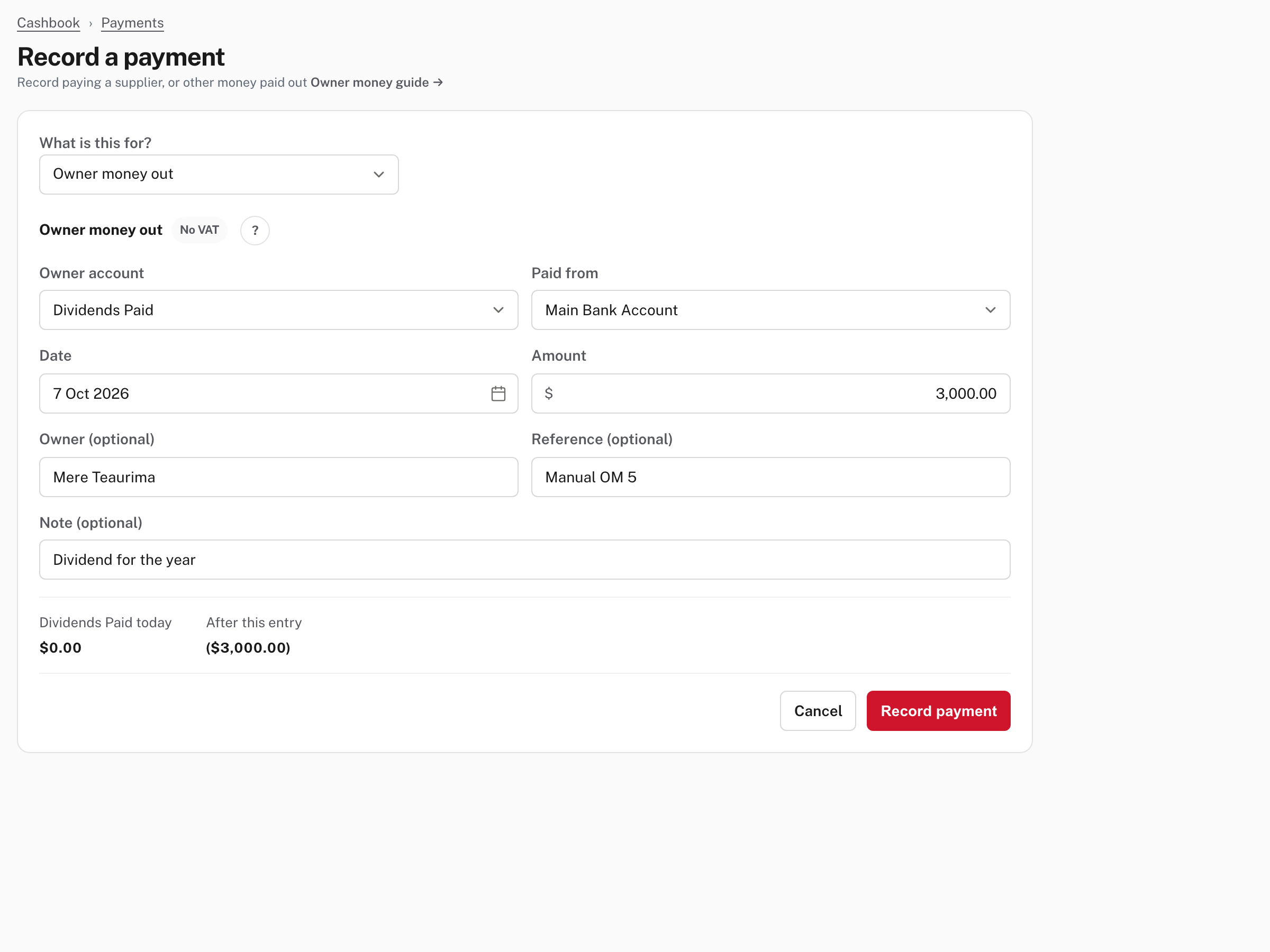
The company tax return reports dividends paid on its own line (Help, and the Company income tax return chapter).
Owner accounts on an ordinary line
An owner account is also offered on a normal receipt or payment, for an entry that mixes owner money with other lines.
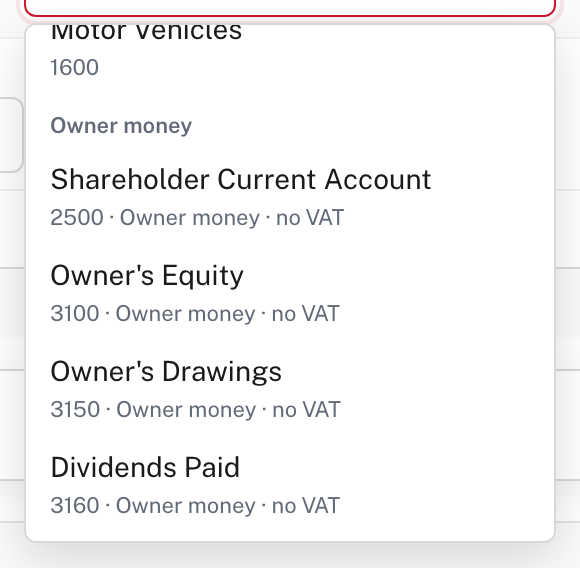
At the end of the Expense type list, the group Owner money holds the four accounts, each marked Owner money · no VAT. In bank reconciliation, Help says coding a statement line to an owner account records it as a receipt or payment in the same way (not pictured).
Step 5. See what happened in your books
Open the receipt and choose See how it was recorded.
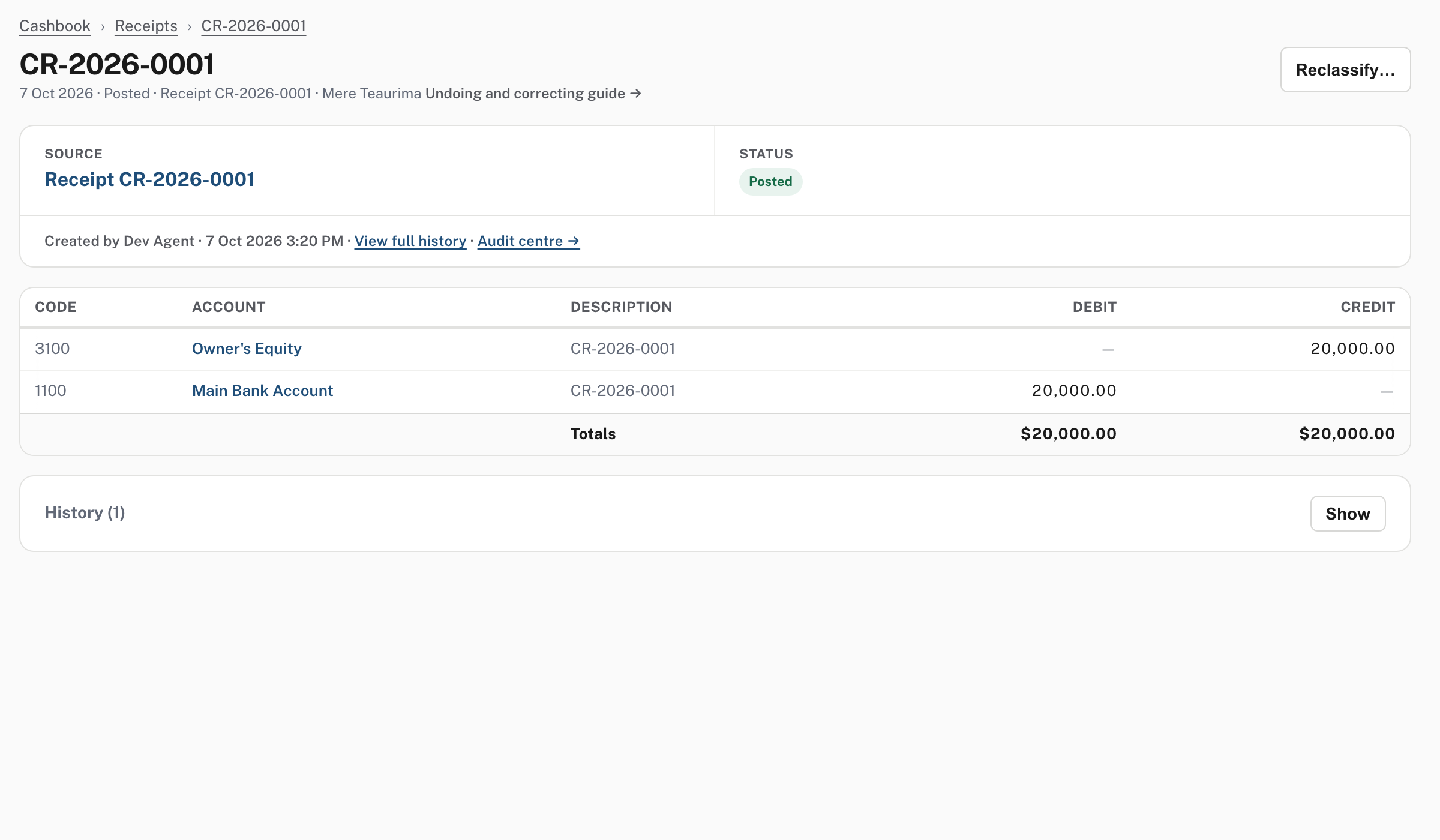
The entry has two lines: the bank debited and Owner's Equity credited. There is no income or expense line and no VAT line, which is why owner money does not touch profit or VAT. Only the capital entry is pictured; Easy's Help says each owner entry is an ordinary receipt or payment and none changes profit.
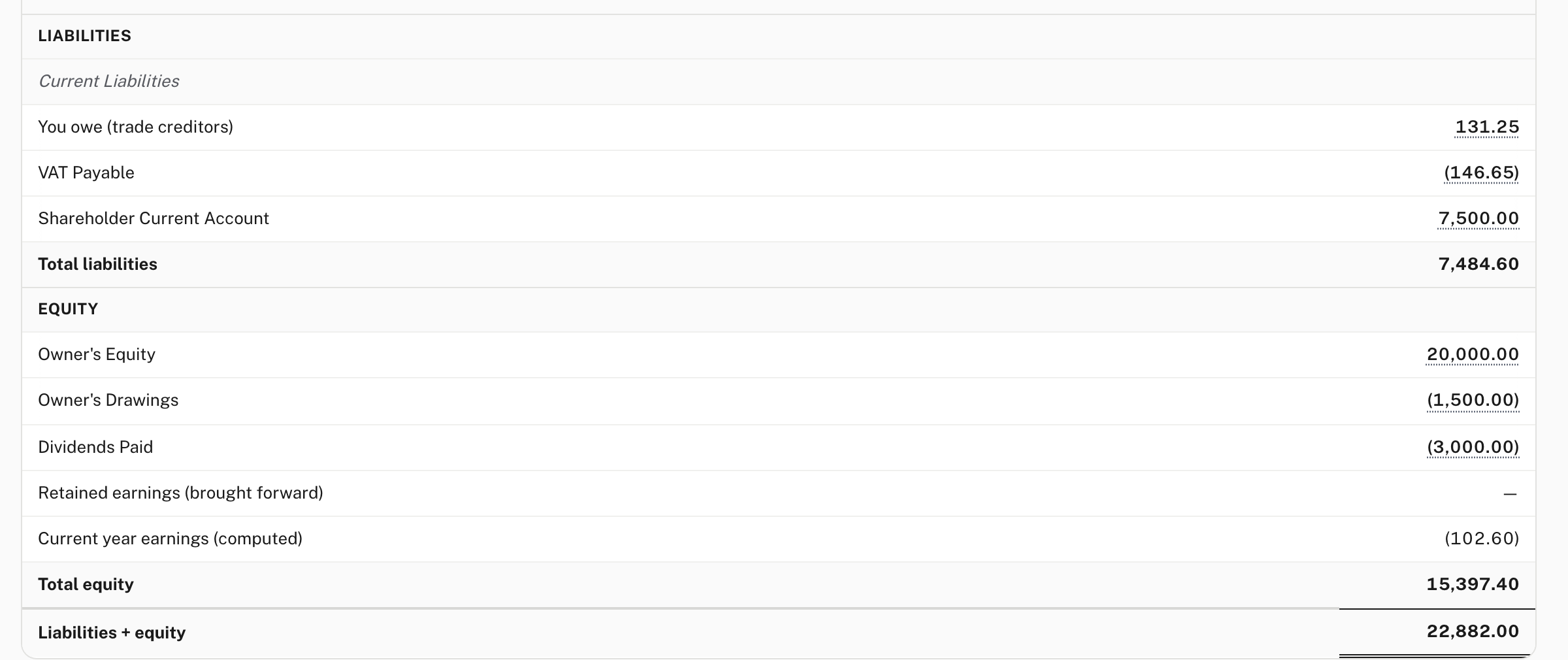
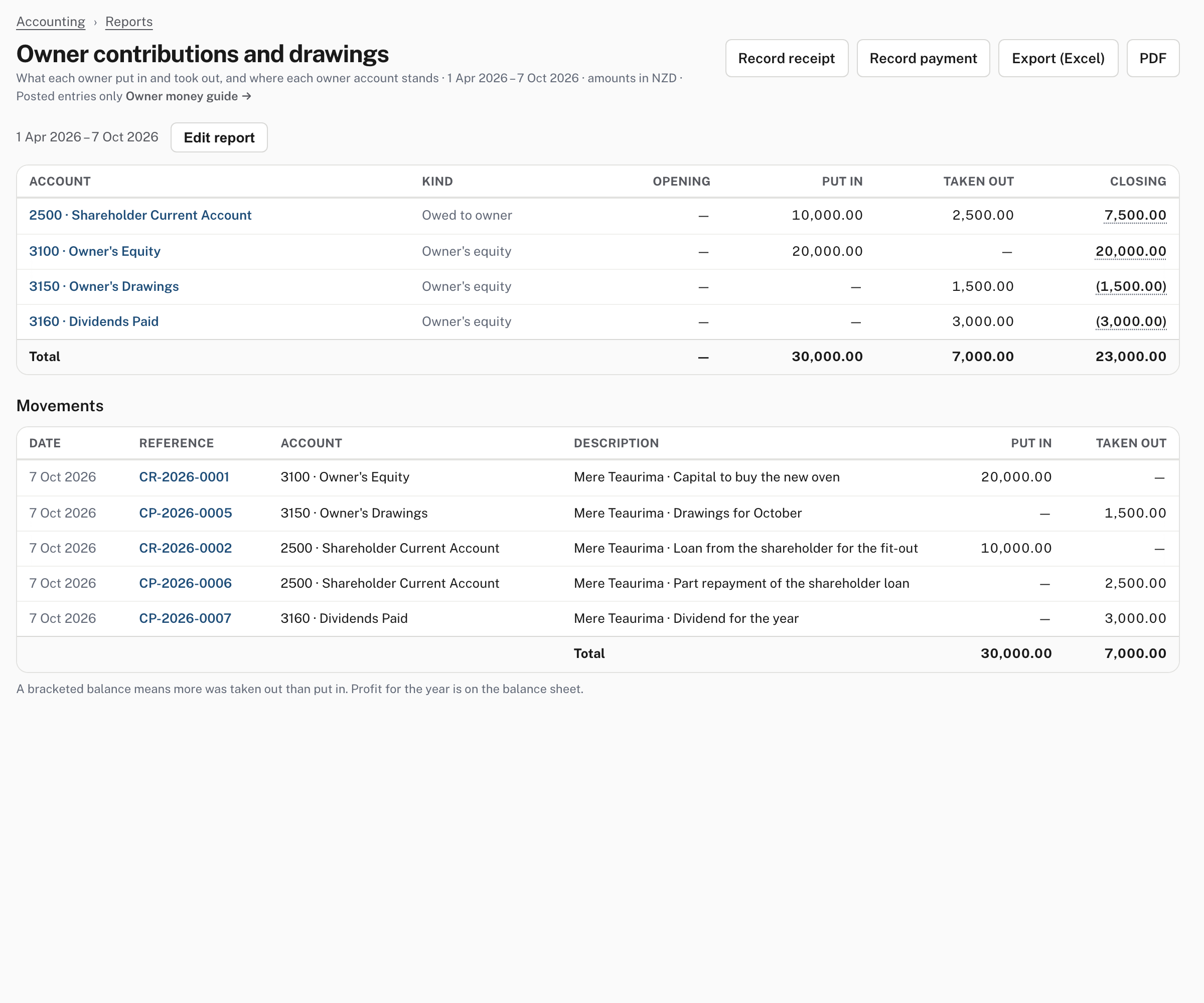
On Accounting → Reports → Balance sheet, the shareholder's loan sits under liabilities ($7,500.00 still owed) and the other owner accounts sit under equity: Owner's Equity $20,000.00 and the two that take money out in brackets, (1,500.00) and (3,000.00). Current year earnings (computed) is the profit for the year, and owner money does not change it (here it reads (102.60), with $30,000 of owner money in the books).
Step 6. Read the owner money report
Accounting → Reports → Owner contributions and drawings.
| Column | What it holds |
|---|---|
| Account and Kind | Each owner account, and whether it is Owner's equity or Owed to owner (a liability). |
| Opening | The balance at the start of the dates you chose. |
| Put in and Taken out | The money moved in each direction in those dates. |
| Closing | The balance at the end. A bracketed balance means more was taken out than put in. |
The default dates are from the start of the financial year to today; Edit report changes them. Below the table, Movements lists every entry with its date, reference, account and description (the owner's name and your note), each linked to its receipt, payment or journal. Each account's name and closing figure open that account's transactions for the same dates. Record receipt and Record payment at the top start a new entry, and Export (Excel) and PDF keep a copy.
The Total row adds every account, so it mixes the liability with the equity accounts: here $23,000.00 is $7,500.00 owed to the shareholder plus $15,500.00 net in equity. Read the report by account, not by the total. Profit for the year is not in this report: it shows on the balance sheet under equity. In the list of receipts, an owner entry shows its type as Other money in:
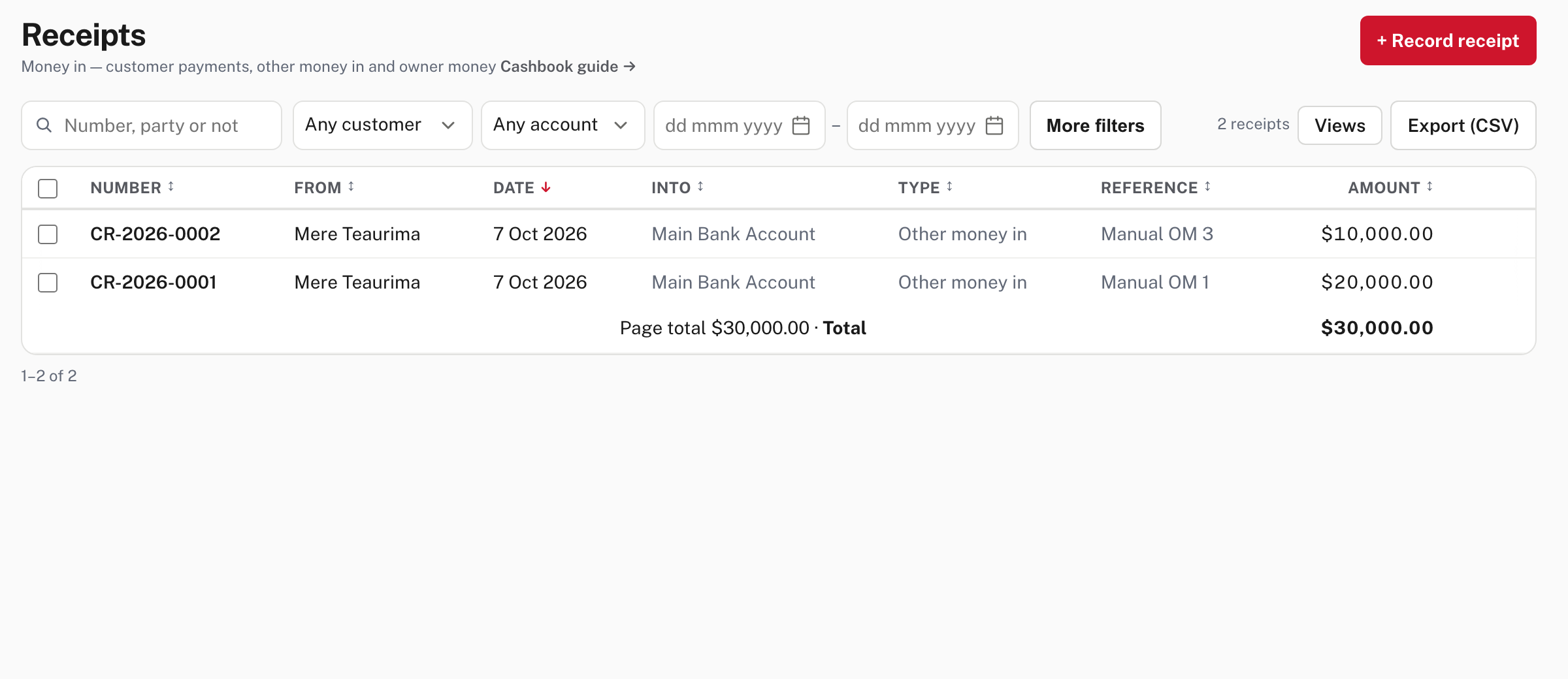
You can find them by the owner's name or your reference in the search box.
Common mistakes
- Recording a shareholder's money as capital. For a limited company it is usually a loan, so use the Shareholder Current Account. If you chose wrongly, a journal between the two owner accounts fixes it.
- Recording drawings as an expense. Use Owner money out to Owner's Drawings, so the profit isn't reduced.
- Recording a dividend to an expense account. Use Owner money out to Dividends Paid, so it stays out of profit and the company tax return finds it there.
- Reading a bracketed closing balance as an error. It means more has been taken out than put in.
Check before you continue
Check before you continue
- Money an owner puts in or takes out is recorded as Owner money in or Owner money out, never as a customer payment, income or an expense.
- Each entry uses the right account: Owner's Equity and Drawings for a sole trader or partnership; Shareholder Current Account and Dividends Paid for a limited company.
- The owner's balance preview on the form matches what you expected before you pressed Record.
- No VAT was charged: the entry shows two lines, the bank and the owner account.
- The report Owner contributions and drawings agrees with what each owner says they put in and took out.
- Your accountant has confirmed anything you were unsure was a loan, capital or a dividend.